
Country’s Profiles
- Geographical Location: North Africa.
- Language(s): Arabic and Tamazight (Official); French is strictly required for official dossier translations and scientific documents
- Population size: About 46 million.
Overview of Algeria’s Medical Device Market
Algeria is the largest country in Africa by land area and one of the continent’s most significant healthcare markets. With a population of about 46 million people and a government continuously advancing and expanding healthcare infrastructure to ensure accessible public healthcare services throughout the entire country, demand for medical devices is substantial and growing. The country imports the majority of its medical devices, making it an attractive destination for international manufacturers looking to expand in the Middle East and North Africa region.
However, entering the Algerian market takes preparation. The regulatory framework has been strengthened considerably over recent years, and all medical devices must now be formally registered with the National Agency for Pharmaceutical Products (L’Agence National des Produits Pharmaceutique – ANPP) before they can be commercially distributed.
This guide walks through every stage of that process: from pre-registration requirements and document preparation, through submission and evaluation, to post-market obligations and upcoming compliance deadlines manufacturers need to be aware of. It provides you summarized contents for the medical devices and IVDs regulation and registration process in Algeria.
Overview of Medical devices and in vitro diagnostic devices regulation
National Regulatory Agency/Authority
In Algeria, any ready-to-use medical device or IVD is subject to strict pre-market registration/homologation overseen ANPP. The system is currently expanding also to a national electronic tracking platform to enforce compliance, health safety, and post-market surveillance and vigilance.
Definitions
Art 212 and 213 of the Health Law No. 18-11 define medical devices as- any instrument, apparatus, implement, machine, appliance, implant, reagent for in vitro use, software, material or other similar or related article, intended by the manufacturer to be used, alone or in combination, for human beings, for one or more of the specific medical purpose(s). This also includes in vitro diagnostic medical devices that are intended for in vitro examination of specimens derived from human body for medical purposes. The definition (in its Art 212) excludes products of human origin. Overall, the definition is very similar to IMDRF’s harmonized definition for medical devices and IVDs.
Legal Documents and Guidelines
● Law 18-11 (2018): Relates to general public health protections
● Law 18-10 (2018): Core regulatory structure for medical devices
● Executive Decree No. 20-324 (Nov 2020) & No. 23-101 (Mar 2023): Defines the exact modalities for medical device homologation and transitional grace periods
● Ministerial Order (Feb 6, 2025): Outlines terms for the exceptional marketing of non-approved medical devices to prevent hospital shortages
● Interministerial Order (Sept 10, 2025): Establishes the framework for regulatory trust and mutual recognition
Classification system and Regulatory Approach
Algeria uses four-class tiers to classify medical devices including IVDs based on their risk profile (i.e. Class I, IIa, IIb, and III). This determines the level of regulatory assessment for pre-market approval and post-market safety and performance monitoring.
Algeria enforces a strict Pre-Market Approval (Homologation) model. However, following the 2025 directives, the ANPP is actively integrating regulatory trust and mutual recognition, accelerating evaluations for devices holding approvals from stringent reference authorities. From February 20, 2027, no shipment can be cleared from port of entry without registration certificate for medical devices that are subject to mandatory registration.
Registration Requirements
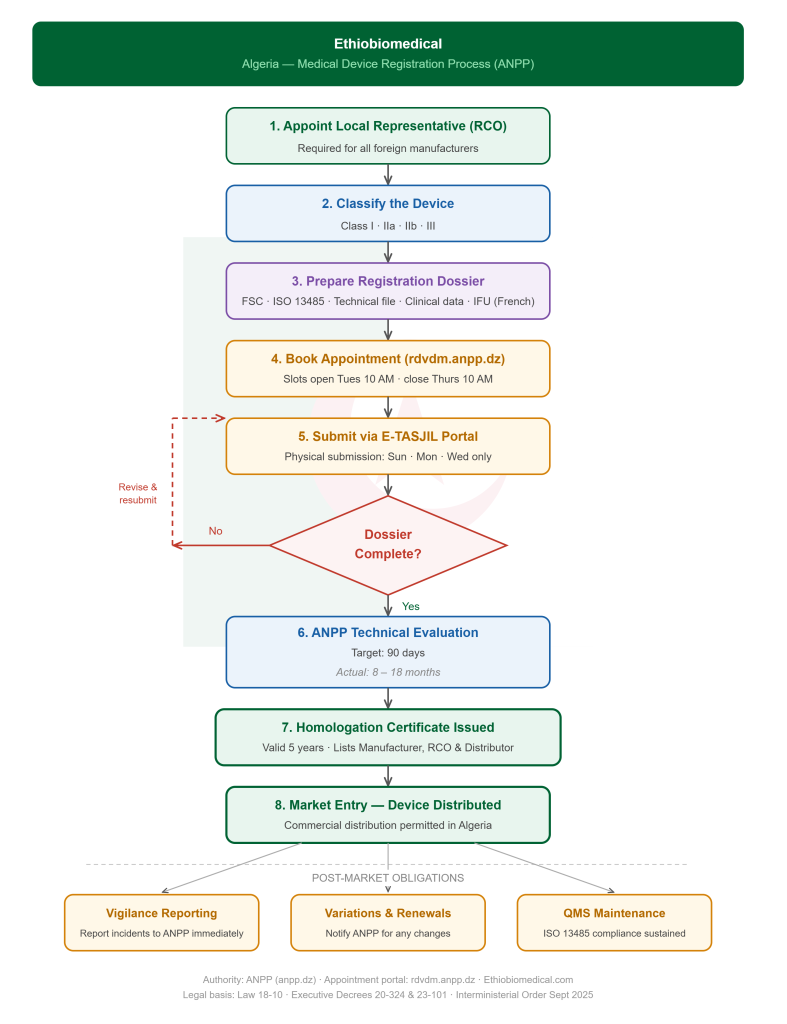
● Local Representation: A local authorized representative, known as the Registration Certificate’s Operator (RCO), must be appointed to handle submissions.
● Documentation: Submissions require a Free Sale Certificate (FSC), ISO 13485 certification, technical specifications, risk analysis, clinical data, and Instructions for Use (IFU) translated officially into French.
Application submission and review process
● E-TASJIL Platform: The entire process is managed via the digital portal. Incomplete digital applications are automatically cancelled.
● Appointment Booking and Dossier Submission: Submitting a medical device dossier requires booking an appointment online. Dossiers are physically received by the ANPP on Sundays, Mondays, and Wednesdays.
Regulatory service fees
The government fees to be charged by ANPP for each application (product) is about 2700 USD (with current exchange rate). This is for new application.
Estimated application processing timelines
The ANPP maintains a target of 90 days for establishing homologation decisions. However, the actual application assessment and approval time varies from 8 to 18 months.
Validity of Marketing authorization Certificate
● Standard Validity: Officially valid for 5 years from issuance, listing the Legal Manufacturer, the RCO, and the Distributor.
● Variations/Renewals: All administrative or technical changes must be notified and approved by the ANPP.
Post-registration regulatory controls
The ANPP operates a stringent post-market surveillance (PMS) and vigilance framework. If an incident occurs, the legal manufacturer, via their local AR, is obligated to immediately notify the ANPP and submit comprehensive incident reports.
Links to useful and related webpages of the Authority (ANPP)
● ANPP Official Website: https://anpp.dz/en/
● MD Appointment Portal: https://rdvdm.anpp.dz/
Want to Register Your Products with the Algerian ANPP?
Our team at Ethiobiomedical can provide expert regulatory affairs support and guidance for medical device registration in Algeria and across Africa. Reach out using the contact form or email us at: admin@ethiobiomedical.com
Disclaimer: This blog post is intended for informational purposes only. While every effort has been made to ensure accuracy and currency of the information provided, regulatory requirements are subject to change. Therefore, the accuracy of the contents of this post can be ensured only at the time of publishing it. Readers are strongly advised to verify all processes and requirements directly with the ANPP before making any regulatory submissions to understand any introduced changes to the submission processes or registration requirements made after this blog is posted. Ethiobiomedical assumes no liability for decisions made based on this content.


